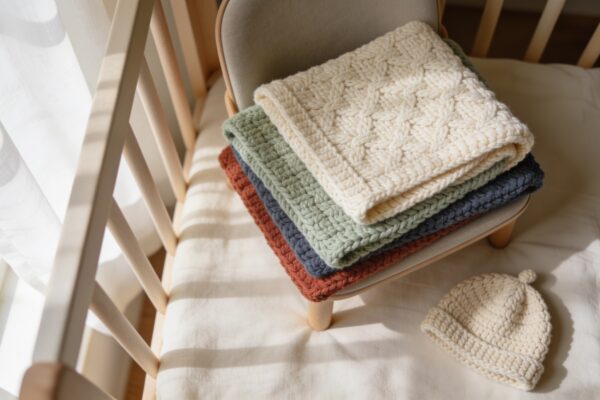
Blankets·The list
22 Newborn Crochet Blanket Patterns for Brand-New Babies
Twenty two patterns, plus the yarn and safety rules that matter for a newborn.
Beginner10 to 20 hours
Every blanket we have, sorted by the stitch it uses and the hours it actually takes.
A blanket is the project most people start and the one most people abandon. It is not difficult. It is long. A lap blanket in worsted yarn on a 5.5 mm hook runs about twenty hours of actual hooking, and a queen-size throw runs closer to sixty.
So the useful question is not which pattern is prettiest. It is which stitch you can work without looking at the chart by row thirty, because that is the row where a blanket is won or lost. Single crochet is dense and slow. Double crochet covers ground twice as fast and is what most free blanket patterns are built on. Moss stitch is the one people memorise fastest, because it is two stitches alternating and nothing else.
Everything below is grouped by that decision. Start with the stitch, then pick the size, then buy the yarn. Buying yarn first is how you end up with eight skeins of something that was lovely in the shop and miserable to work with.
One stitch, no colour changes, no shaping. Finish one of these and the rest of the section opens up.
Pick the texture first. The stitch decides the drape, the yarn use and how fast it goes.
Size and yarn change completely depending on who ends up under it.
Hours are real hooking time in double crochet with worsted yarn on a 5.5 mm hook. Add roughly a third if you are working single crochet, and take off about a quarter for bulky.
| Size | Finished | Worsted skeins | Hours |
|---|---|---|---|
| Lovey | 40 x 40 cm | 1 | 3 to 4 |
| Baby | 75 x 90 cm | 3 to 4 | 15 to 20 |
| Lap | 100 x 125 cm | 6 to 7 | 25 to 35 |
| Throw | 125 x 150 cm | 9 to 11 | 40 to 50 |
| Queen | 225 x 230 cm | 20 to 24 | 80 to 110 |
Buy every skein in one go and check the dye lot on the band. Yarn from a different lot is a slightly different colour, and it shows as a band across the middle of a finished blanket in a way it never shows in the shop.
Yarn is the largest cost in a blanket and the easiest thing to get wrong. A throw takes nine to eleven skeins of worsted, so a two pound difference per skein is twenty pounds across the project. That is worth ten minutes of thinking about.
Machine washable, cheap, comes in every colour, and it is what most free blanket patterns assume. It squeaks slightly on the hook and it pills over a few years. For a blanket that lives on a sofa and gets washed monthly, it is the right answer and nobody should feel bad about it.
Heavier, no stretch, and it shows stitch definition beautifully. It also has no memory, so a cotton blanket grows under its own weight and keeps growing. Good for baby blankets and anything that will be washed constantly. Bad for a large throw unless you want it to end up longer than you planned.
Warmest per gram and the nicest to work with. Untreated wool felts in a warm wash, which turns a blanket into a mat in one mistake. Superwash wool solves that and costs more. If you are making something for a baby or for someone who will not read a care label, use superwash or acrylic.
| Fibre | Warmth | Washes | Drape | Cost per throw |
|---|---|---|---|---|
| Acrylic | Good | Machine, cold | Soft, slightly springy | Low |
| Cotton | Low | Machine, warm | Heavy, stretches over time | Medium |
| Superwash wool | High | Machine, cold | Excellent | High |
| Untreated wool | Highest | Hand wash only | Excellent | High |
| Chenille | Good | Machine, gentle | Very soft, hides stitches | Medium |
Chenille and other velvet yarns hide stitch definition almost completely. If you have chosen a pattern for its texture, chenille will erase the thing you chose it for. Use it for plain single or double crochet where softness is the point.
Gauge matters less in a blanket than in a garment, because nothing has to fit. What matters is the starting chain, because that is the only measurement you cannot fix later without starting again.
Work a swatch of about twenty stitches in the pattern you have chosen, measure how wide ten stitches are, then divide your target width by that. If ten double crochet measure 12 cm and you want a 125 cm throw, you need roughly 104 stitches. Round to whatever the pattern repeat needs.
That swatch takes fifteen minutes. Starting a blanket without it is how people end up with something the width of a scarf and the length of a bed.
Chain loosely, then count. A tight foundation chain is the most common cause of a blanket that curls along the bottom edge and never lies flat no matter how hard it is blocked.
A border is what makes a blanket look finished rather than stopped. Even a single round of single crochet in the main colour tidies every edge and hides the slight unevenness at the row ends that every crocheter has.
If the blanket is made of squares or strips, joining is a project in itself. Slip stitch joins are flat and invisible. Single crochet joins leave a visible ridge, which can be the point. Whip stitching with a needle is slowest and neatest. Joining as you go is fastest overall and the hardest to undo if you change your mind about the layout.
Almost always the turning chain. Some patterns count it as a stitch and some do not, and doing the opposite of what the pattern assumes adds or loses one stitch every row. Count row one, then count row ten.
Tension changed partway through, usually because you started working in front of the television. It blocks out on wool and it does not block out on acrylic. On acrylic you can steam it gently, holding the iron above the fabric and never touching it, or you can decide it is a handmade blanket and leave it.
You added stitches. Count back to find the row where the count changed and frog to there. It is painful and it is faster than trying to decrease your way out of it later.
Check the dye lot before buying more, and if the lot is different, work the last few rows and the whole border in the new lot so the change reads as a design choice rather than a mistake.
A moss stitch blanket in worsted yarn. It is two stitches alternating, there is no chart, and you can see your mistakes immediately because the pattern breaks visibly.
For a lap blanket in worsted, about 1,400 metres, which is six or seven standard skeins. Bulky yarn needs fewer skeins but more metres of actual length per row.
Whatever the yarn band says, then go up half a millimetre. Blankets want drape, and a hook half a size larger gives you that without changing the pattern.
You are adding stitches at the turn. Count the first row, then count row ten. If ten is longer, you are working into the turning chain when the pattern does not ask you to.
If it is acrylic or superwash wool, yes, cold and on a gentle cycle inside a duvet cover. Untreated wool will felt. Cotton is fine but comes out heavier and takes a day to dry flat.
The foundation chain is too tight. Chain with a hook one size larger than the one you work the body with, then switch back after the first row.
Blankets·The list
Twenty two patterns, plus the yarn and safety rules that matter for a newborn.
Beginner10 to 20 hours