 Save
Granny·The list
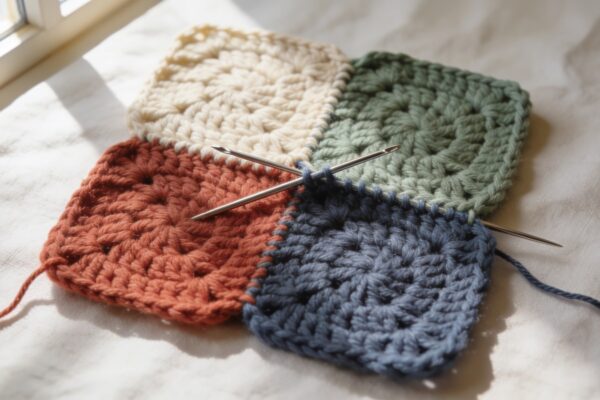
6 Ways to Join Granny Squares, Ranked by Neatness
Six joins compared on how they look, how long they take and how flat they lie.
Easy1 to 6 hours
The square everyone starts with, and the joins that make it look finished.
A granny square is three double crochet, chain one, repeated around a ring, growing outward with a corner made of two clusters in the same space. That is it. Every variation is that idea with something changed.
It is the most portable project in crochet. One square takes about eight minutes, needs no chart once you have done three, and fits in a coat pocket. That portability is why granny square blankets get finished and single-piece blankets often do not.
The part nobody warns you about is the joining and the ends. A 120-square blanket has 240 ends to weave in, and joining takes roughly as long as making the squares did. Plan for it.
One evening, and then you have it permanently.
Once you can make one, the project is just a question of how many.
Assumes a 15 cm square in worsted yarn, which is what a standard six-round granny comes out at on a 5.0 mm hook.
| Project | Finished | Squares | Making time |
|---|---|---|---|
| Cushion cover | 45 x 45 cm | 18 | About 3 hours |
| Baby blanket | 75 x 90 cm | 30 | About 5 hours |
| Lap blanket | 105 x 135 cm | 63 | About 10 hours |
| Throw | 120 x 150 cm | 80 | About 13 hours |
| Double bed | 180 x 210 cm | 168 | About 28 hours |
Add roughly half the making time again for joining and weaving in ends. On a throw that is another six or seven hours, and it is the stage where most square blankets stall.
Weave in each square ends as you finish that square. Twenty seconds each time is unnoticeable. Two hundred and forty of them in one sitting at the end is how a blanket ends up in a bag for a year.
About eight minutes for a standard six-round square in worsted yarn, once you know the pattern.
5.0 mm with worsted yarn. If your squares come out cupped rather than flat, go up half a size.
The corners need two clusters with a chain between. One cluster gives you a rounded corner and the square gradually becomes a circle.
Whip stitch with a yarn needle, using the same yarn as the final round. It is the slowest and it disappears completely.
Yes. A solid granny square worked in one colour is faster, has far fewer ends, and shows the texture better than a multicolour one.
Same hook, same yarn, same number of rounds, and check one against the first every ten squares. Tension drifts over a long project and it is easier to correct early.
SaveGranny·The list
Six joins compared on how they look, how long they take and how flat they lie.
Easy1 to 6 hours