
 Save
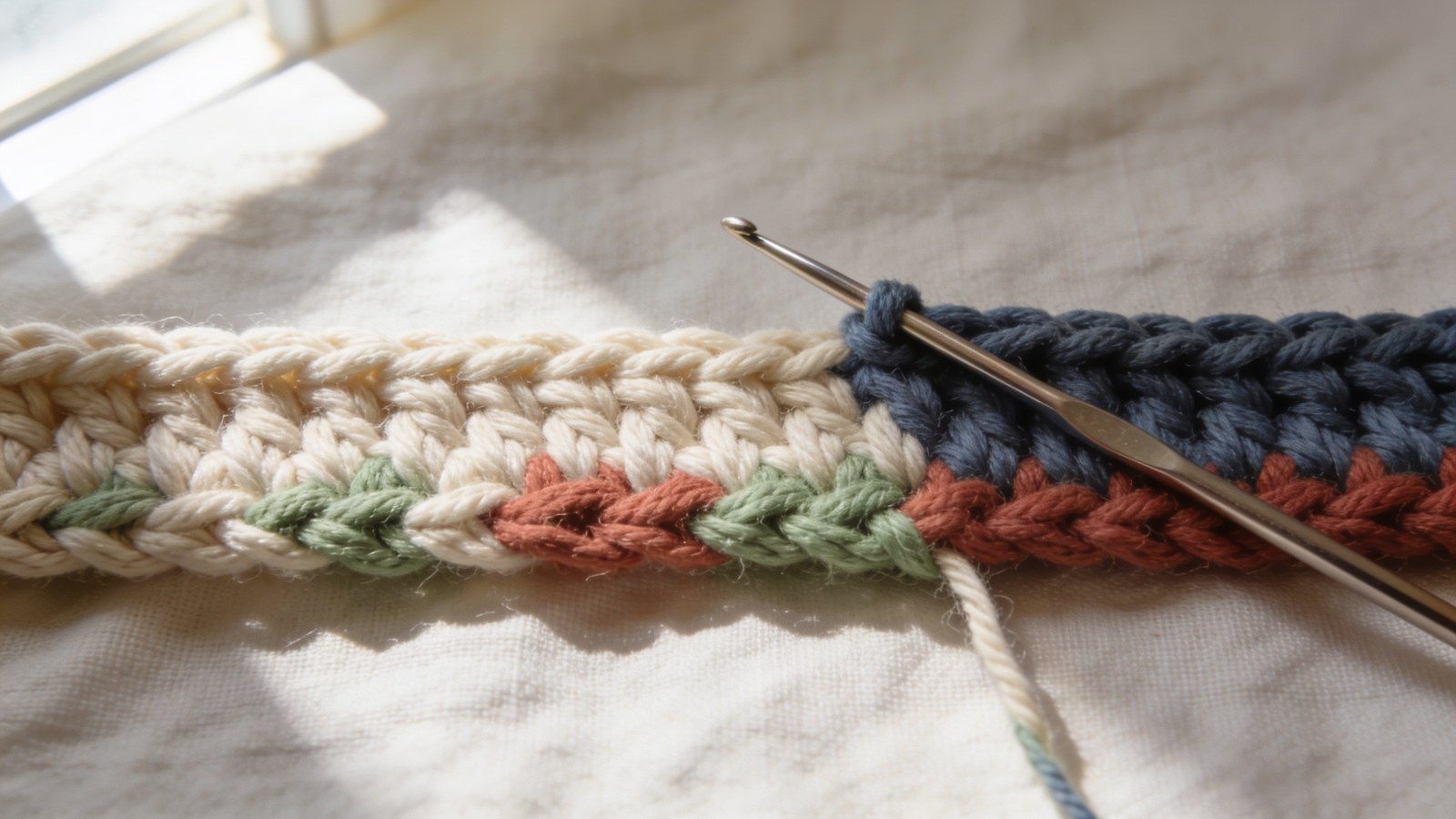
SaveDouble crochet is the stitch you will use more than any other. Most blanket patterns are built on it, most garment patterns too, and once it is automatic the majority of free patterns stop looking like code.
Part of our stitches library.
It is taller than single crochet, which means it covers ground roughly twice as fast, and it has more give, which is why it drapes better. That combination is why it dominates.
This page uses US terms. A US double crochet is a UK treble. If your pattern says “treble” for this stitch, it is a UK pattern and everything in it is offset by one name.
Working it, step by step
- Yarn over before you go anywhere. This is the step people forget, and forgetting it makes a single crochet instead.
- Insert the hook into the next stitch, under both loops of the V on top.
- Yarn over and pull up a loop. You now have three loops on the hook.
- Yarn over, pull through two. Two loops left.
- Yarn over, pull through the last two. One loop left. That is one double crochet.
Say it out loud a few times while you work: over, in, through, two, two. By the third row your hands will do it without the words.
The turning chain, which causes most of the trouble
A double crochet row is turned with three chains, and those three chains stand in for the first stitch. Whether you then work into the top of that chain at the end of the next row is the single most common source of edges that wander.
| If the pattern says | Do this | Result |
|---|---|---|
| Chain 3 counts as a stitch | Skip the first stitch, work into the ch-3 at the end | Straight edge |
| Chain 3 does not count | Work into the first stitch, ignore the ch-3 at the end | Straight edge |
| Nothing at all | Assume it counts, and be consistent | Straight edge either way |
Consistency matters more than which convention you pick. Doing it one way on row four and the other way on row five is what produces the gradual narrowing everybody gets at first.
The three things that go wrong
The work narrows row by row
You are losing the last stitch, which hides under the turning chain. Count the stitches at the end of every row for ten rows. It is dull and it fixes the habit permanently.
There is a gap at the start of each row
The chain-3 is standing too tall. Try chaining only two and treating that as the stitch. Many crocheters find ch-2 gives a tidier edge, and no pattern will object.
The fabric is stiff and will not drape
The hook is too small for the yarn, or your tension has tightened. Go up half a hook size. Double crochet is supposed to be a loose, airy stitch, and if it feels like canvas it is not doing its job.
How it compares
| Stitch | Height | Rows per 10 cm | Speed |
|---|---|---|---|
| Single crochet | Short | About 14 | Slowest |
| Half double | Medium | About 11 | Middle |
| Double crochet | Tall | About 8 | Fast |
| Treble | Very tall | About 6 | Fastest, and open |
Questions
What is double crochet?
A stitch worked by yarning over first, then pulling through two loops twice. It stands about twice the height of a single crochet.
Is double crochet the same in UK patterns?
No, and this catches everybody once. A US double crochet is a UK treble. A UK double crochet is a US single.
How many chains do I turn with?
Three is standard, though two gives a tidier edge for many people. Whichever you pick, be consistent within a project.
Why is my double crochet getting narrower?
You are missing the last stitch of each row, which sits under the turning chain. Count for ten rows and the habit corrects itself.
How much yarn does double crochet use?
Slightly more per stitch than single crochet, but far fewer stitches cover the same area, so a finished piece usually works out about the same.
What can I make once I know it?
Most free blanket patterns, most scarves, and a large share of garment patterns. It is the stitch that unlocks the widest range.